


If you’re exploring a forensic science career, one of the first questions you’ll ask is: What is a blood spatter analyst’s salary in 2026? The short answer is that most professionals in this specialization earn between $62,000 and $99,000+ per year, depending on experience, certifications, and location.
Because bloodstain pattern analysis is often grouped under forensic science technicians, authoritative salary data from Salary.com and BLS-backed occupation categories show a national average of around $62,939, while specialized bloodstain roles on live job boards trend closer to $99,157 annually.
This guide breaks down how much blood spatter analysts make, what affects earning potential, the highest-paying states, education requirements, certifications, and long-term career growth.
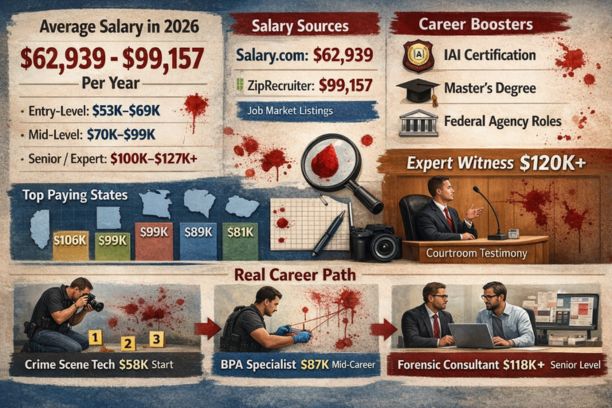
The average blood spatter analyst salary in 2026 ranges from $62,939 to $99,157 per year in the U.S.
- Entry-level: $53,000–$69,000
- Mid-level: $70,000–$99,000
- Senior / Expert witness: $100,000–$127,000+
- Top states: Illinois, California, Ohio, Maryland, Oregon
- Best salary boosters: IAI certification, master’s degree, federal agency roles, courtroom testimony experience
What Does a Blood Spatter Analyst Do?
A blood spatter analyst (also called a bloodstain pattern analyst) is a specialized forensic professional who studies the shape, size, direction, distribution, and physics of bloodstains at crime scenes.
Core Responsibilities
- Collecting and preserving blood evidence
- Reconstructing the sequence of violent events
- Determining the impact angle and force
- Identifying possible weapon movement
- Using photography and 3D software
- Writing courtroom-ready reports
- Testifying as an expert witness
This role blends biology, mathematics, fluid dynamics, crime scene reconstruction, and legal communication.
Blood Spatter Analyst Average Salary in 2026
When people search “how much does a blood spatter analyst make”, the answer depends on whether we use:
- Government occupational data (forensic science technicians)
- Live job market salary postings
- Specialized niche forensic roles
National Salary Benchmarks
|
Salary Source |
Average Annual Salary |
Best Use |
|
Salary.com – Forensic Science Technician |
$62,939 |
Conservative national baseline |
|
ZipRecruiter – Bloodstain Pattern Analyst |
$99,157 |
Specialized niche estimate |
|
Indeed – Forensic Science Technician |
$54,564 |
Employer-reported average |
|
Salary.com – Forensic Scientist |
$104,896 |
Advanced forensic roles |
What This Means
The blood spatter analyst’s average salary is generally higher than standard forensic technician pay because the skillset is specialized, often rare, and frequently tied to court testimony and homicide investigations.
Salary by Experience Level
Entry-Level (0–2 Years)
Most new professionals start as:
- forensic lab assistants
- CSI technicians
- forensic science technicians
- junior evidence analysts
Expected salary: $53,000–$69,000/year
Mid-Level (3–7 Years)
At this level, analysts begin:
- leading scene reconstructions
- preparing courtroom exhibits
- mentoring junior CSIs
- working on the violent crime divisions
Expected salary: $70,000–$95,000/year
Senior-Level (8+ Years)
Highly experienced analysts may work as:
- senior BPA experts
- homicide reconstruction consultants
- state lab specialists
- federal forensic experts
Expected salary: $100,000–$127,000+
Highest Paying States for Blood Spatter Analysts
Using forensic science technician wage benchmarks, these states consistently rank highest:
|
State |
Avg. Salary |
|
Illinois |
$106,120 |
|
California |
$99,390 |
|
Ohio |
$89,330 |
|
Maryland |
$82,730 |
|
Oregon |
$81,460 |
|
New York |
$80,470 |
These numbers align strongly with:
- Higher homicide lab budgets
- state crime labs
- urban forensic demand
- Higher court testimony volume
What Factors Affect Blood Spatter Analyst Salary?
1) Certification
The International Association for Identification (IAI) BPA certification significantly improves salary potential because it proves courtroom-grade expertise.
2) Education
- Bachelor’s = minimum
- Master’s = higher promotion potential
- PhD = teaching/consulting advantage
3) Employer Type
Higher salaries are common in:
- federal agencies
- state crime labs
- private forensic consulting
- legal consulting firms
4) Courtroom Experience
Expert witness testimony adds premium value.
5) Geographic Cost of Living
Large metro crime labs often pay more.
How to Become a High-Paid Blood Spatter Analyst
Step 1: Earn a Bachelor’s Degree
Best majors:
- Forensic Science
- Criminal Justice
- Biology
- Chemistry
- Physics
Step 2: Build Lab + Scene Experience
Internships matter heavily for ranking into homicide or major crimes units.
Step 3: Complete BPA Workshops
Take specialized training in:
- impact angle analysis
- stringing methods
- trajectory reconstruction
- fluid dynamics
Step 4: Earn Certification
IAI and IABPA training pathways are highly respected authority signals.
Step 5: Move into Expert Testimony
This is where salaries often jump above $100K+.
Real-Life Example
A real-world example helps readers understand the salary journey.
Case Example:
A forensic science graduate starts in Texas at $58,000/year as a crime scene technician. After 5 years, completing BPA certification and assisting homicide detectives, they transition into a state forensic reconstruction unit, earning $87,000/year. By year 10, after repeated courtroom testimony and advanced scene reconstruction work, they move into supervisory forensic consulting at $118,000+ annually.
This progression mirrors actual forensic career ladders discussed by professionals in the field.
Job Outlook for 2026 and Beyond
The Bureau of Labor Statistics places this career under Forensic Science Technicians, a field projected to grow much faster than average, with about 2,600 openings per year.
Why Demand Is Growing
- DNA + blood evidence reliance
- violent crime reconstruction
- cold case reopening
- courtroom expert testimony
- digital scene modeling
This makes bloodstain analysis one of the most future-resilient niches in forensic science.
Final Verdict
If your goal is to combine science, criminal investigation, mathematics, and courtroom impact, bloodstain pattern analysis remains one of the most compelling forensic niches in 2026.
The salary potential is strong:
- $62K+ starting benchmark
- $80K–$100K realistic mid-career
- $120K+ senior expert ceiling
More importantly, this career offers rare specialization, strong demand, and real-world investigative impact.
If you’re serious about entering this field, start by:
- earning a forensic science degree
- building crime scene experience
- pursuing BPA certification
- targeting high-paying state or federal labs
That path gives you the best chance to maximize blood spatter analyst salary, long-term authority, and career growth in forensic science.
FAQs
1) How much do blood spatter analysts make in 2026?
Most earn $62,000–$99,000 annually, with senior experts exceeding $120,000.
2) How much does a blood spatter analyst make per hour?
The average hourly equivalent ranges from $30 to $47+ per hour.
3) Is blood spatter analysis a high-paying career?
Yes, compared with general forensic technician roles, BPA specialists often earn higher due to courtroom and homicide specialization.
4) What degree do you need?
A bachelor’s in forensic science, biology, chemistry, or criminal justice.
5) Do certifications increase salary?
Absolutely. IAI certification can increase trust, court admissibility, and compensation.
6) Which states pay the most?
Illinois, California, Ohio, Maryland, and Oregon.
7) Can you make over $100K?
Yes—especially in federal labs, consulting, or supervisory roles.
8) Is blood spatter analysis in demand?
Yes, demand remains strong through at least 2032.
9) How long does it take to become one?
Usually 4–6 years, including degree + specialized training.
10) Is this better than general CSI work?
For salary growth, yes—because it’s more specialized and expert-driven.