U.S.–Iran Tensions Escalate as Military Signals, Sanctions, and Unrest Push Region to the Brink
January 2026 — Relations between the United States and Iran have entered one of their most volatile phases in years, marked by heightened military activity, sharp political rhetoric, deepening sanctions, and widespread unrest inside Iran. As both nations signal readiness rather than restraint, the international community is increasingly concerned that a miscalculation could ignite a wider regional conflict.
A Show of Force in the Middle East
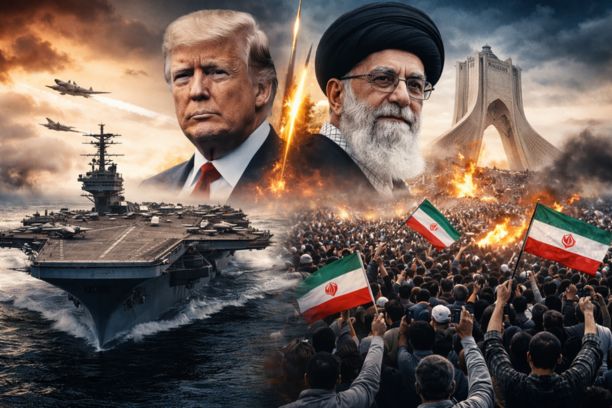
Washington has taken a visibly firmer posture in recent days, ordering the movement of significant naval and military assets toward the Middle East. U.S. officials describe the deployment as a defensive measure designed to deter threats to American interests and regional allies. The presence of advanced warships and surveillance capabilities sends a clear message: the United States is prepared to respond swiftly to any escalation.
American leadership has framed the buildup as a warning rather than a declaration of intent, emphasizing that the goal is stability — not war. Still, the scale and timing of the deployment have fueled speculation that Washington is bracing for a potential confrontation.
Tehran’s Defiant Response
Iran has responded with uncompromising language. Senior military commanders have declared that any attack on Iranian territory would be treated as an act of full-scale aggression, triggering an immediate and decisive response. Iranian officials insist their armed forces are on the highest level of alert, portraying readiness as a matter of national survival rather than provocation.
State media in Iran has amplified this rhetoric, portraying the U.S. military movement as evidence of hostility while framing Iran’s stance as defensive. The exchange of warnings has hardened positions on both sides, narrowing diplomatic space at a time when tensions are already dangerously high.
Sanctions Tighten the Pressure
At the heart of the standoff is economic pressure. The United States has intensified sanctions targeting Iran’s energy exports, shipping networks, and financial channels. These measures aim to limit the government’s access to revenue while increasing pressure on decision-makers in Tehran.
Iranian leaders argue that sanctions amount to economic warfare, blaming them for inflation, currency collapse, and shortages of essential goods. Washington counters that sanctions are a non-military tool intended to curb destabilizing actions and force accountability without resorting to armed conflict.
Unrest Inside Iran Deepens the Crisis
Complicating the geopolitical confrontation is widespread unrest within Iran. Protests have erupted across multiple cities, driven by economic hardship, political frustration, and anger over governance. Security forces have responded forcefully, leading to casualties, arrests, and prolonged disruptions to daily life.
The government has imposed communication restrictions, limiting internet access and curbing the flow of information. These measures have intensified international concern while fueling domestic resentment. Analysts note that internal instability adds another unpredictable layer to an already tense standoff with the United States.
Regional and Global Ripples
The effects of the U.S.–Iran standoff are being felt far beyond the two nations. Airlines have adjusted flight routes, energy markets are reacting nervously, and neighboring countries are bracing for possible fallout. Diplomatic channels across the Middle East are working behind the scenes to prevent escalation, aware that any direct clash could rapidly draw in multiple actors.
Global powers are urging restraint, warning that a conflict would disrupt trade routes, strain humanitarian systems, and destabilize an already fragile region.
A Dangerous Crossroads
Despite the sharp rhetoric, neither Washington nor Tehran has formally declared an intention to go to war. Yet the combination of military posturing, economic pressure, internal unrest, and mutual distrust has created a volatile environment where small incidents could spiral quickly.
For now, the standoff remains a high-stakes game of signals and counter-signals — one where diplomacy struggles to keep pace with escalation. As the world watches closely, the question is no longer whether tensions exist, but whether cooler heads can still prevent them from turning into open conflict.