U.S.–Cuba Relations at a Crossroads: Rising Tensions, Diplomatic Strains, and What Comes Next
U.S.–Cuba relations have once again entered a period of heightened tension, marked by diplomatic friction, public protests, economic hardship, and renewed geopolitical maneuvering. More than six decades after the Cuban Revolution reshaped the Caribbean nation’s political identity and its relationship with Washington, the two countries remain locked in a complex and often adversarial dynamic. Recent events — including demonstrations in Havana, warnings from U.S. officials, humanitarian aid negotiations, and Cuba’s deepening economic crisis — have underscored how fragile and unresolved this bilateral relationship remains.
For policymakers, analysts, and ordinary citizens on both sides of the Florida Straits, the current moment raises pressing questions. Is this another cycle of confrontation destined to fade into stalemate? Or does it signal a more significant turning point in how the United States and Cuba engage with one another in an evolving global landscape?
What’s Happening Now: A Snapshot of Current Developments
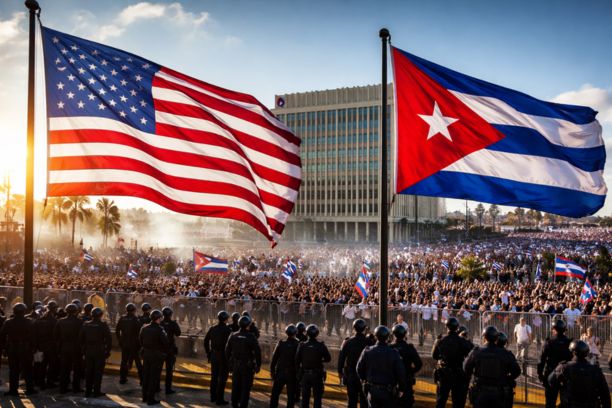
The latest phase of U.S.–Cuba tensions has been shaped by a convergence of political, economic, and humanitarian pressures. In recent weeks, Cuban authorities have overseen mass rallies condemning U.S. policies, particularly economic sanctions and what Havana describes as interference in its internal affairs. These demonstrations have been framed domestically as a defense of national sovereignty and a response to mounting external pressure.
At the same time, Washington has continued to express concern over human rights conditions in Cuba, reiterating calls for political freedoms, the release of detainees, and greater space for civil society. While the U.S. government has maintained sanctions aimed at Cuba’s leadership and security apparatus, it has also signaled willingness to provide limited humanitarian assistance following natural disasters and infrastructure failures — a dual-track approach that reflects both confrontation and cautious engagement.
These developments unfold against the backdrop of Cuba’s most severe economic crisis in decades, creating a volatile mix of internal strain and external pressure.
A Brief History of U.S.–Cuba Relations
To understand the current tensions, it is essential to revisit the historical roots of the U.S.–Cuba relationship. Following the 1959 Cuban Revolution led by Fidel Castro, Cuba aligned itself with the Soviet Union, prompting the United States to sever diplomatic ties and impose a sweeping economic embargo. Throughout the Cold War, Cuba became a focal point of U.S.–Soviet rivalry, most notably during the 1962 Cuban Missile Crisis.
For decades, relations remained frozen, defined by ideological hostility, covert operations, and mutual suspicion. It was not until 2014 that a major shift occurred, when the Obama administration announced a normalization process that restored diplomatic relations, reopened embassies, and eased certain travel and trade restrictions.
However, this thaw proved fragile. Subsequent policy reversals reimposed sanctions and narrowed engagement, returning the relationship to a more confrontational footing. Today’s tensions reflect this oscillation between engagement and isolation, with no clear consensus in Washington or Havana on a sustainable path forward.
The Core Sources of Today’s Tensions
Economic Sanctions and the U.S. Embargo
At the heart of U.S.–Cuba tensions lies the longstanding U.S. embargo, which restricts trade, investment, and financial transactions with the island. U.S. officials argue that sanctions are a necessary tool to pressure Cuba’s government over human rights and democratic reforms. Cuban authorities, meanwhile, blame the embargo for exacerbating shortages, limiting economic growth, and deepening hardship for ordinary citizens.
Internationally, the embargo has faced consistent criticism, with many countries arguing that it disproportionately harms civilians and hinders economic recovery. The debate over sanctions remains one of the most contentious and emotionally charged aspects of bilateral relations.
Human Rights and Political Freedoms
Human rights concerns represent another major fault line. The United States has repeatedly criticized Cuba for restricting political dissent, limiting freedom of expression, and detaining protesters. Cuban officials counter that these measures are necessary to maintain stability and protect the country from foreign-backed destabilization.
This fundamental disagreement over governance and sovereignty continues to block meaningful dialogue, reinforcing mistrust on both sides.
Migration Pressures
Migration is both a humanitarian issue and a political flashpoint. Economic hardship has driven increasing numbers of Cubans to seek opportunities abroad, often risking dangerous journeys to reach the United States. While both governments have occasionally cooperated on migration management, disagreements over responsibility, visa processing, and border enforcement persist.
Protests, Public Sentiment, and Nationalism in Cuba
Public demonstrations in Cuba have become a visible symbol of the current tensions. Government-organized rallies frequently emphasize resistance to U.S. pressure and celebrate national resilience. At the same time, spontaneous expressions of public frustration — driven by shortages, power outages, and declining living standards — reflect deeper social and economic stress.
The Cuban government has sought to channel public anger outward, framing the United States as a central cause of the country’s difficulties. This narrative resonates with many Cubans, particularly older generations shaped by revolutionary history, but it also competes with growing calls for internal reform and accountability.
The Humanitarian Crisis and International Response
Cuba’s humanitarian situation has grown increasingly severe. Chronic shortages of fuel, food, and medicine have strained daily life, while power outages and infrastructure failures have disrupted essential services. Hospitals and schools face resource constraints, and emigration has depleted key sectors of skilled workers.
In this context, humanitarian aid has emerged as a rare area of limited cooperation. The United States has offered targeted assistance following natural disasters and emergencies, while emphasizing that aid should reach civilians directly. Cuban authorities have cautiously accepted such support while warning against political conditions or interference.
International organizations and non-governmental groups continue to play a critical role, though their operations are often constrained by regulatory and political barriers.
Geopolitical Dimensions Beyond Washington and Havana
U.S.–Cuba relations do not exist in isolation. Cuba’s close ties with countries such as Russia, China, Venezuela, and Iran add a broader geopolitical dimension to the relationship. These partnerships provide Havana with economic support, diplomatic backing, and strategic leverage, while fueling U.S. concerns about influence in the Western Hemisphere.
For Washington, Cuba’s alliances raise questions about regional security and competition with global rivals. For Havana, they represent an alternative to reliance on the United States and a means of resisting pressure. This global context complicates any bilateral reset, as U.S.–Cuba relations are increasingly entangled with wider geopolitical rivalries.
Diplomatic Channels: Is Dialogue Still Possible?
Despite the tensions, diplomatic channels between the United States and Cuba remain open, albeit limited. Embassies continue to operate, and technical discussions have taken place on issues such as migration, law enforcement cooperation, and disaster response.
However, progress toward broader normalization has stalled. Deep mistrust, domestic political constraints in both countries, and competing priorities have prevented sustained engagement. For now, diplomacy appears focused on managing risks rather than resolving underlying disputes.
Expert Perspectives and Political Analysis
Foreign policy analysts describe the current phase of U.S.–Cuba relations as a familiar pattern: pressure without clear pathways for change. Some argue that sanctions and isolation have failed to produce political reform and instead entrenched hardline positions. Others contend that easing pressure without concrete concessions would legitimize repression.
Within Cuba, economists and social commentators increasingly warn that prolonged crisis could erode institutional stability. In the United States, policymakers remain divided between advocates of engagement and proponents of a tougher stance.
What Comes Next: Possible Scenarios
Several scenarios could shape the future of U.S.–Cuba relations. Tensions could intensify through additional sanctions and rhetorical escalation. Alternatively, pragmatic cooperation on humanitarian issues and migration could expand gradually. A more ambitious reset would require political will on both sides — a prospect that remains uncertain.
Absent major change, the most likely outcome is continued stalemate: limited engagement, persistent mistrust, and ongoing hardship for ordinary Cubans.
Why U.S.–Cuba Relations Matter Globally
The trajectory of U.S.–Cuba relations carries implications beyond the two countries. It affects migration patterns across the Americas, shapes U.S. credibility in Latin America, and reflects broader debates about the effectiveness of sanctions as a foreign policy tool. The relationship also serves as a reminder of how Cold War legacies continue to influence modern diplomacy.
Conclusion
More than sixty years after their rupture, the United States and Cuba remain bound by history, geography, and unresolved grievances. Today’s tensions highlight the limits of pressure and the costs of prolonged confrontation. While diplomacy remains possible, trust is scarce, and meaningful change will require difficult choices on both sides.
As Cuba confronts deep internal challenges and the United States reassesses its role in the region, the future of their relationship remains uncertain. What is clear, however, is that the consequences of this enduring standoff extend far beyond government offices — shaping the lives of millions and the political landscape of the wider Americas.