


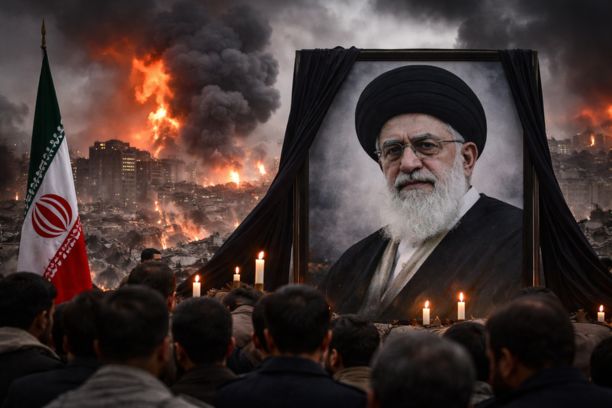
TEHRAN — Iran’s highest authority, Supreme Leader Ayatollah Ali Khamenei, was killed in a massive series of coordinated military strikes in Tehran, Iranian state media confirmed Sunday. The event marks a seismic shift in the Islamic Republic’s 47-year history and has plunged the Middle East into a state of high-alert military escalation.
Key Facts
-
Victim: Ayatollah Ali Khamenei, age 86.
-
Casualties: Reports indicate at least 40 senior officials and members of Khamenei’s immediate family, including his daughter and grandchild, were also killed.
-
Responsibility: Confirmed as a joint operation by United States and Israeli forces.
-
Status: Iran has declared 40 days of national mourning and a seven-day public holiday.
-
Succession: A transitional council led by President Masoud Pezeshkian has assumed temporary authority.
The Operation: Strikes on the Capital
According to official reports from IRNA and state television, precision aerial attacks struck the Supreme Leader’s office and several key government compounds early Saturday morning. While initial reports were shrouded in uncertainty, US President Donald Trump confirmed the death via social media, describing the operation as a “success” intended to end decades of regional threats.
Eyewitnesses in Tehran described widespread destruction in the government quarter, with emergency services reporting over 200 deaths nationwide following the wave of strikes targeting IRGC command centers and missile sites.
Iran Vows “Severe Retaliation”
The response from Tehran was immediate. The Islamic Revolutionary Guard Corps (IRGC) characterized the death as a “martyrdom” and announced that its “most intensive” offensive has already begun.
Retaliatory strikes have been reported across the region, with explosions heard near US military installations and allied hubs in Dubai, Doha, and Manama. Iranian President Pezeshkian condemned the assassination as a “great crime,” vowing that the nation would respond with “strength and resolve.”
Legacy of the Supreme Leader
Ayatollah Ali Khamenei served as the ultimate authority in Iran since 1989, succeeding the Islamic Republic’s founder, Ayatollah Ruhollah Khomeini. For over three decades, he wielded absolute power over Iran’s military, judiciary, and foreign policy. His tenure was defined by a fierce rivalry with the West, the expansion of Iran’s regional proxy network, and a “hardline” approach to domestic dissent.
Regional and Global Fallout
The impact of the strikes has been felt instantly across global markets and infrastructure:
-
Aviation Chaos: Over 440 flights have been cancelled across the Middle East. Major carriers, including Air India and Emirates, have suspended operations to the region until further notice.
-
Maritime Alert: Major shipping groups, including Hapag-Lloyd and CMA CGM, have suspended transit through the Strait of Hormuz, effectively closing one of the world’s most vital oil arteries.
-
International Reaction: Russia has called for an emergency session of the IAEA, warning of a potential “radiological catastrophe” if nuclear sites are impacted, while the UN Secretary-General has appealed for immediate restraint.
What Comes Next?
Under Iran’s constitution, a transitional leadership council is now managing state affairs. This council is tasked with organizing the selection of a new Supreme Leader through the Assembly of Experts within 50 days.
However, analysts warn that the vacuum left by Khamenei, combined with the ongoing military exchanges, creates a period of unprecedented instability. “We are in uncharted territory,” said one Middle East security expert. “The internal power struggle and the external military conflict are now feeding into one another.”