Pakistan Declares Open War on Afghanistan, Kabul Bombed Amid Rising Casualties
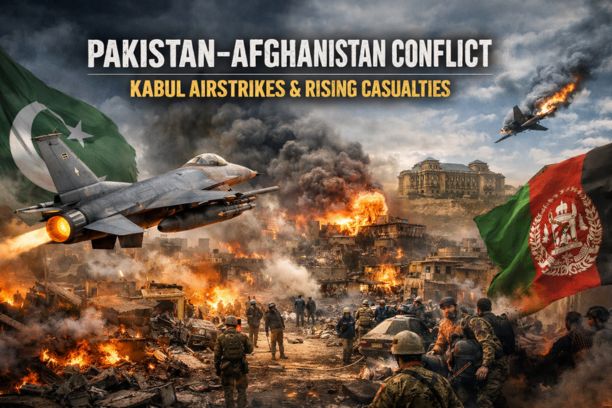
Tensions between Pakistan and Afghanistan have sharply escalated after Pakistan reportedly declared “open war” and carried out airstrikes in Kabul, marking one of the most serious military confrontations between the two neighbors in recent years.
International media outlets are widely covering the development as cross-border hostilities intensify, with both sides issuing strong statements and unverified battlefield claims.
Pakistan Launches Airstrikes in Kabul
According to emerging reports, Pakistani forces conducted bombing operations in Kabul, the capital of Afghanistan. Casualty figures remain contested, but early estimates suggest more than 130 people may have been killed.
This escalation follows earlier cross-border incidents in recent months that reportedly resulted in dozens of deaths near the Pakistan–Afghanistan border. The latest strike represents the most significant military action so far.
Independent confirmation of the exact casualty numbers is still pending.
Khawaja Asif’s Strong Statement Signals Escalation
Pakistan’s Defense Minister, Khawaja Asif, issued a sharply worded statement addressing the crisis.
In his remarks:
- He referenced the 2021 NATO withdrawal from Afghanistan under U.S. President Joe Biden.
- He accused Afghanistan’s Taliban leadership of allowing militant groups to operate against Pakistan.
- He alleged that Afghanistan had effectively become a proxy aligned against Pakistani interests.
- He stated that Pakistan had exhausted diplomatic efforts and that its “patience has overflowed.”
The language used in the statement has been interpreted by analysts as a formal declaration of open hostilities.
Claim of Pakistani Fighter Jet Shot Down
Amid the bombing campaign, Afghan sources claimed that one Pakistani fighter jet was shot down during operations.
Reports initially suggested the aircraft could have been either:
- An F-16 Fighting Falcon, or
- A JF-17 Thunder
However, a video circulating online that allegedly shows a downed F-16 has been widely described as unverified and potentially fabricated. As of now, there is no confirmed independent evidence that Pakistan has lost an aircraft.
Military officials from Pakistan have not publicly confirmed any losses.
Does Afghanistan Have the Air Defense Capability?
The reports have raised questions about Afghanistan’s ability to counter advanced fighter jets.
While Afghanistan’s air force is considered limited, the country is believed to possess:
- MANPADS (Man-Portable Air Defense Systems)
- U.S.-supplied FIM-92 Stinger missiles left behind after the 2021 withdrawal
- Older Soviet-era anti-aircraft guns
Security analysts note that while Stinger missiles can be effective against low-flying aircraft, operational readiness, ammunition availability, and trained personnel remain uncertain factors.
Taliban Claims Retaliatory Strikes
Taliban officials have claimed retaliatory military operations against Pakistani border posts.
According to Taliban statements:
- 13 Pakistani military posts were allegedly destroyed in eastern regions.
- 19 Pakistani soldiers were reportedly killed.
- Fighting remains ongoing in several border areas.
These claims remain independently unverified at the time of reporting.
Strategic Concerns Over Bagram Airbase
Some geopolitical observers suggest that the broader strategic context may involve Bagram Airbase, a former U.S. military base located north of Kabul.
While there is no official confirmation of plans involving the airbase, analysts argue that any sustained military push toward Kabul could have implications for control of key infrastructure sites like Bagram.
The airbase previously served as a major operational hub for U.S. and NATO forces during their presence in Afghanistan.
Regional and Global Implications
The sudden escalation raises serious regional stability concerns:
- Pakistan has accused the Taliban of enabling anti-Pakistan militant groups.
- Afghanistan has accused Pakistan of violating sovereignty through airstrikes.
- Broader powers, including the United States and China, are expected to closely monitor developments.
The crisis could mark a defining moment in Pakistan–Afghanistan relations, with potential long-term geopolitical consequences.
Current Situation: What We Know So Far
- Pakistan has reportedly conducted airstrikes in Kabul.
- Casualty numbers are reported to exceed 130 but remain unconfirmed.
- Pakistan’s Defense Minister has publicly framed the situation as open war.
- Afghan sources claim to have shot down a Pakistani jet, but no independent confirmation exists.
- Cross-border fighting is reportedly ongoing.
The situation remains fluid, and further developments are expected in the coming days
For latest news updates visit: lawyerwrites.com