


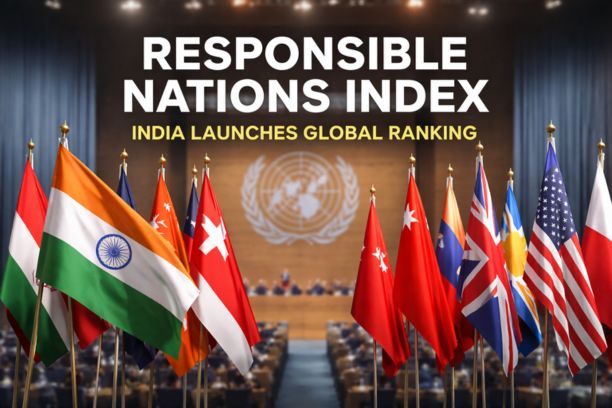
India has introduced a new global ranking framework known as the Responsible Nations Index, designed to assess countries based on governance responsibility, geopolitical conduct, and environmental performance.
The index is positioned as an alternative to existing international rankings that often prioritize economic indicators or perception-based measures. According to its framework, national responsibility is evaluated through three broad criteria: a country’s relationship with its own citizens, its impact on the international community, and its contribution to environmental sustainability.
Ranking Methodology
The Responsible Nations Index does not rely on a single dataset. Instead, it compiles findings from internationally accepted reports, combining multiple indicators to assess whether countries:
- Maintain internal political and social stability
- Avoid actions that contribute to geopolitical tension
- Engage responsibly with international institutions
- Meet climate and environmental commitments
Economic size and military power are not treated as primary indicators.
Top-Ranked Countries
In the inaugural index:
- Singapore is ranked first
- Switzerland ranks second
- Other high-ranking countries include Denmark, Sweden, Cyprus, Belgium, and the Czech Republic
India is ranked 16th, ahead of France, while the United Kingdom is ranked 25th.
Rankings of Major Global Powers
Several major geopolitical powers are placed significantly lower in the index:
-
The United States is ranked 66th, reflecting concerns related to geopolitical interventions and withdrawal from certain multilateral institutions
-
China is ranked just below the United States, citing regional tensions in the South China Sea, border disputes, and military pressure on neighboring states
-
Russia is ranked 96th, primarily due to its ongoing military conflict in Ukraine
Other notable rankings include:
- Bangladesh at the 42nd
- Israel at 43rd
- Pakistan at 90th
- Turkey at 94th
Countries affected by prolonged conflict and humanitarian crises, including Syria, Sudan, and the Central African Republic, appear at the bottom of the index.
Environmental and Climate Factors
Environmental responsibility forms a key component of the index. India’s ranking is partly attributed to its climate record, with the country cited as the only G20 nation to have met its climate change commitments, according to internationally recognized assessments.
The index distinguishes between national contributions to global climate goals and domestic environmental challenges, such as air quality management, which are evaluated separately.
International Engagement and Governance
The index considers continued participation in global institutions as a measure of responsible international behavior. Countries that have withdrawn from or disengaged with international organizations are ranked lower under this framework.
India’s position reflects its ongoing engagement with multilateral institutions, its democratic governance structure, and large-scale domestic welfare programs, including food security initiatives.
Launch and Institutional Support
The Responsible Nations Index was launched in New Delhi through the World Intellectual Property Foundation, with academic involvement from Jawaharlal Nehru University (JNU). The initiative aims to provide an alternative perspective on global responsibility and governance.
Limitations and Visibility
While the index presents a comprehensive framework, its creators acknowledge challenges related to accessibility and visibility. Limited online availability and presentation may restrict its international reach unless accompanied by broader dissemination and independent review.
Broader Context
The launch of the Responsible Nations Index reflects a broader trend in global governance, in which emerging powers seek to shape how international responsibility, legitimacy, and leadership are measured. As debates over geopolitical conduct and climate accountability continue, such indices may increasingly shape global policy discussions.